Lincoln and the Border States by William C. Harris
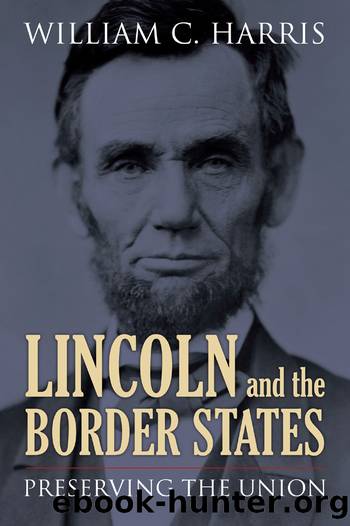
Author:William C. Harris [Harris, William C.]
Language: eng
Format: epub
Tags: History, United States, Civil War Period (1850-1877), Political Science, Political Process, Leadership, American Government, Executive Branch
ISBN: 9780700618040
Google: bo4jKQEACAAJ
Publisher: University Press of Kansas
Published: 2011-01-15T04:17:51+00:00
After Lincoln issued his preliminary Emancipation Proclamation in September 1862, Marylandâs Union leaders, like those in Missouri, gradually and grudgingly began to consider a way to end slavery with the least possible disruption to the social and economic system and, perhaps more important, to their notions of race control and public support for the war. They also knew that Lincoln in nearby Washington had a keen interest in the stateâs affairs. Although the proclamation did not apply to the border states, the president wanted Marylanders to adopt a plan of emancipation, preferably gradual emancipation, that would include federal compensation if Congress was willing. Many Maryland Unionists, like those in Missouri, recognized that the war was rapidly undermining slavery, with blacks fleeing to freedom in the District of Columbia, to army camps, and northward. It had become a constant battle for slaveholders to retrieve their slaves in the national capital, where their complaints had been increasingly ignored by an unsympathetic president and federal military officers.
By 1863 Governor Bradford, who had opposed the antislavery resolution at the Altoona governorsâ conference in September 1862, saw the handwriting on the wall for the extinction of slavery. However, not until months after Lincoln had issued the final Emancipation Proclamation on January 1 did Bradford endorse state action to end the âpeculiar institution.â Postmaster General Blair quietly recommended to friends in his home state that they should support a gradual plan of emancipation, along with the colonization of blacks. Henry Winter Davis, an enemy of the Blairs in Maryland politics, had emerged as the leader of a minority that demanded immediate emancipation. Davis, who would soon become a vitriolic spokesman for the radical Republicans in Congress, had become incensed by the presidentâs support for the Blairs. He also denounced Montgomery Blairâs colonization scheme as a delusion.37 At the same time, the proslavery faction of Unionists, soon a dwindling minority, had powerful spokesmen in lame-duck senator Anthony Kennedy and Representative John W. Crisfield, a large slaveholder and a talented statesâ rights politician. After rejecting Lincolnâs compensation plan earlier and before they committed the state to emancipation, Maryland Unionists wanted assurances from Congress that the federal government would provide the funds to compensate loyal slaveholders for the loss of their chattels. They would soon be disappointed.
Delawareâs political leadership proved more hostile to the Emancipation Proclamation than neighboring Maryland Unionists. Proud of the fact that theirs was the first state to ratify the Constitution of 1787, as well as imbued with an inferiority complex because of the stateâs increasing political insignificance, Delawareâs elite recoiled at any slight to their rights, including the right to own slaves. They had developed considerable political skill in defending their rights, and while maintaining allegiance to the Republic of the Founders, they perceived themselves as southerners, not northerners. Elected in the fall of 1862 on a platform opposing Lincolnâs policies, the new legislature in January denounced the presidentâs proclamation and his suspension of the writ of habeas corpus on September 24, 1862. The legislators
Download
This site does not store any files on its server. We only index and link to content provided by other sites. Please contact the content providers to delete copyright contents if any and email us, we'll remove relevant links or contents immediately.
The Secret History by Donna Tartt(19092)
The Social Justice Warrior Handbook by Lisa De Pasquale(12191)
Thirteen Reasons Why by Jay Asher(8912)
This Is How You Lose Her by Junot Diaz(6889)
Weapons of Math Destruction by Cathy O'Neil(6281)
Zero to One by Peter Thiel(5802)
Beartown by Fredrik Backman(5756)
The Myth of the Strong Leader by Archie Brown(5509)
The Fire Next Time by James Baldwin(5448)
How Democracies Die by Steven Levitsky & Daniel Ziblatt(5219)
Promise Me, Dad by Joe Biden(5154)
Stone's Rules by Roger Stone(5088)
A Higher Loyalty: Truth, Lies, and Leadership by James Comey(4964)
100 Deadly Skills by Clint Emerson(4927)
Rise and Kill First by Ronen Bergman(4790)
Secrecy World by Jake Bernstein(4753)
The David Icke Guide to the Global Conspiracy (and how to end it) by David Icke(4720)
The Farm by Tom Rob Smith(4514)
The Doomsday Machine by Daniel Ellsberg(4490)
